Old Spey Concepts and Their Relevance to Surf SpeyBy Mark Severino
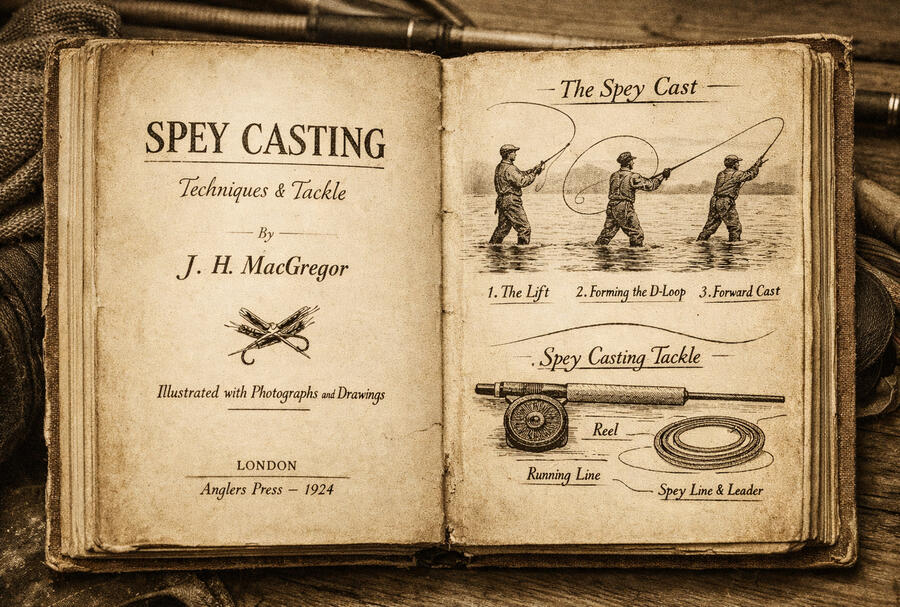
This article highlights the original Spey concepts that remain directly relevant to Surf Spey today.Surf Spey is a modern system built for a modern environment, but many of its underlying principles echo the earliest descriptions of Spey casting from the late 1800s and early 1900s.Those early anglers fished in moving water, relied on tension, and cast without backcasts long before modern styles existed. They described behaviors and geometric requirements that align closely with what the surf demands today.The Forward Turn: The Earliest ResetEarly Spey descriptions often mentioned a “forward turn” or “forward throw” between swings. W. Earl Hodgson described this as bringing the rod forward to prepare for the next movement (Hodgson 1908).The forward turn is the foundation of Surf Spey:
• It restores geometry
• It aligns the rod tip
• It reestablishes tension
• It prepares the cast for a forward only strokeThe surf forces this behavior every cast. The earliest Spey anglers recognized the same need in moving water. This forward turn is the Victorian ancestor of the modern surf reset, the same mechanical solution applied in a harsher environment.Working Under TensionVictorian Spey anglers wrote about “keeping the line alive” and avoiding slack. A. E. Knox emphasized that the line must remain under control and in motion (Knox 1854).In the surf, tension is not just helpful; it is the system’s engine. The old principle of working under tension becomes a defining requirement.The Compact StrokeBefore modern styles, Spey casting was compact, efficient, and bottom-hand driven. Jock Scott described it as a short, firm movement with the lower hand doing the work (Scott 1924).These characteristics align directly with Surf Spey. The surf punishes long, drifting, and rising strokes. It rewards compact geometry, the same geometry described in the earliest Spey writing.Casting Without a BackcastSpey casting was created because anglers had no room behind them. George Kelson noted that the Spey cast was designed for banks where backcasting was impossible (Kelson 1895).The surf imposes the same constraint:
• no backcast room
• no stable footing
• no fixed anchor point
• no time for repositioningThe Straight Path of the Rod TipEarly writers did not use modern loop theory, but they described the need for the rod to travel forward, be true, and not wander.Francis Francis wrote that the rod should move in a straight line toward the intended course of the line (Francis 1867).
They were describing the same geometric requirement that Surf Spey depends on.The Forward StopA.E. Knox and Francis Francis both described the forward finish of the cast in language that emphasized control, alignment, and clean turnover long before modern loop theory existed. In Autumns on the Spey (1854), Knox wrote that the cast should end with “a decisive check,” a firm but unforced moment that allowed the line to travel straight and true.Francis echoed the same idea in A Book on Angling (1867), using phrases such as “a firm finish” and “a clean turnover” to describe the forward throw, smoothly brought to a stop, so the loop could form without wandering.Neither man suggested force or a violent stop; they were identifying the same geometric truth Surf Spey depends on today: the rod must finish forward, on plane, and under control for the loop to stabilize in moving water.Although these early descriptions come from rivers, they are not relics of a bygone style. They describe the same geometric and tension-based realities that Surf Spey must solve today.Modern river casters often mitigate these old problems with efficient direction change casts, but the underlying issue- geometry collapsing at the end of the swing- has never changed.The surf removes the modern workaround. With no stable anchor and limited time to form a D loop, the surf forces the angler back into the original behaviors the early writers documented: restore geometry, keep the line alive, drive the rod forward on a straight path, and finish with a controlled, decisive forward check.In this way, the oldest Spey concepts are the functional backbone of Surf Spey.The Living AnchorEarly descriptions mentioned the fly “kissing the water” or “holding to the surface” under current. These writers did not name the anchor, but they understood its behavior in moving water (general descriptions of the Spey, 1850–1900).The term “anchor” did not exist in Victorian vocabulary, but the behavior was clearly recognized and described.W. Earl Hodgson (Salmon Fishing, 1908) described the fly:
• “Resting on the surface.”
• “Held by the current until the forward cast is made.”The Wind Cutting LoopJock Scott, Greased Line Fishing for Salmon (1924), is the first major Spey writer to talk directly about loop integrity.Scott wrote that the forward cast must produce a loop that:
• holds its shape in the wind
• flies efficiently
• travels straight without collapsing
The surf demands:
• tight loops
• straight trajectories
• efficient turnoverClosing
Across seventy years of early Spey literature, Knox, Francis, Kelson, Hodgson, and Scott all described a Spey cast built on tension, alignment, economy, and clean forward turnover.Knox emphasized the river’s role and the need for a “decisive check.” Francis insisted the rod must not wander and must finish with a “clean turnover.”Kelson described the fly “held by the stream,” recognizing anchor behavior. Hodgson emphasized rhythm and a firm forward finish.Scott distilled the doctrine into its purest form: “no unnecessary movement.”Modern Spey casts were not written about until the late 1980s and early 1990s. Everything before that (1854–1924) is the Victorian mechanical foundation.The period between 1924 and 1985 is largely undocumented in print, with most mechanical evolution preserved orally among ghillies and regional anglers.Everything after 1985 is modern Spey.
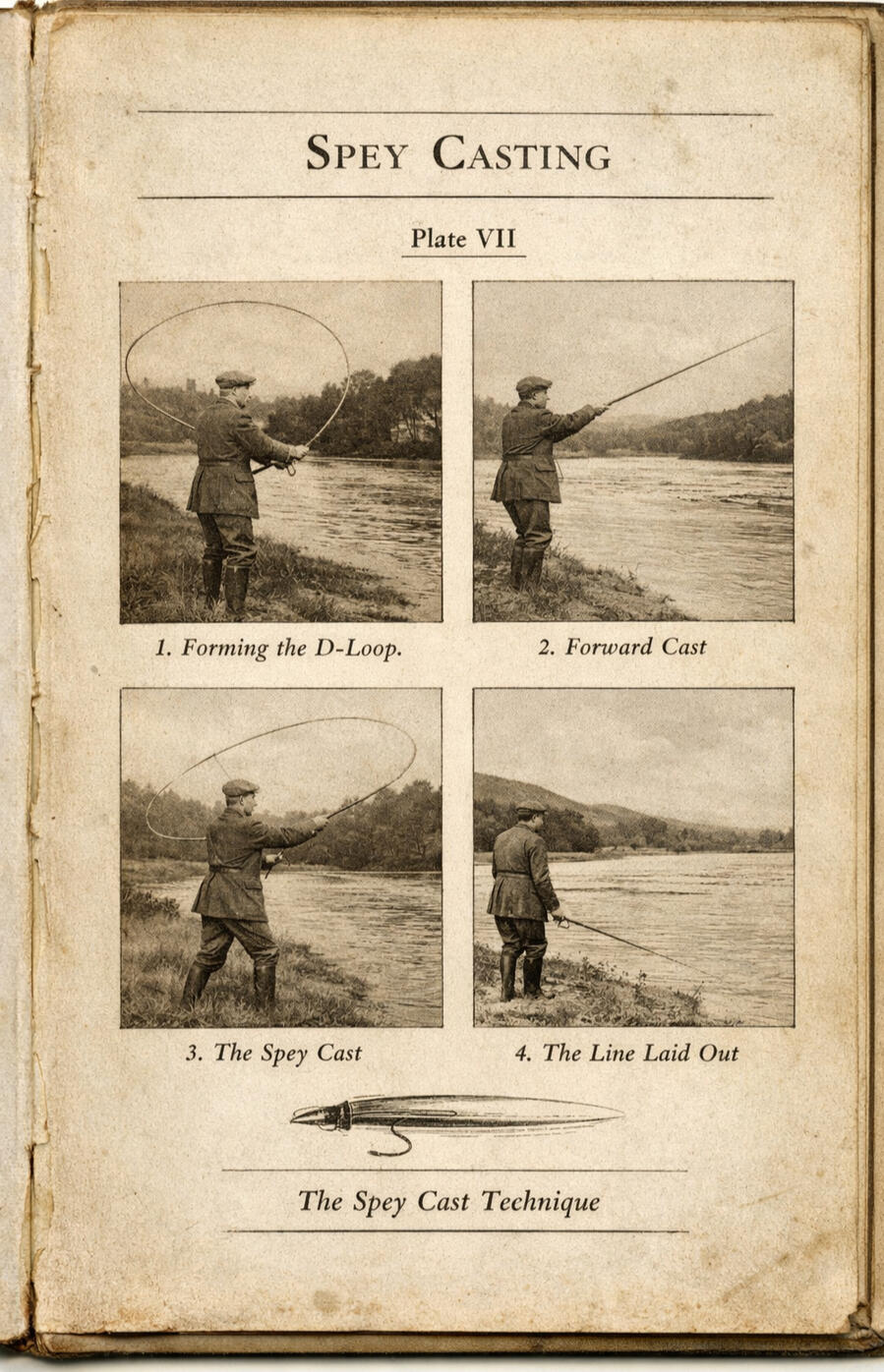
The Lost Era of Spey Casting (1924–1985)This article documents the undocumented period of Spey casting — the oral era — and explains how its mechanical evolution leads directly into Surf Spey.The Oral Transmission Period
Between 1924 and 1985, Spey casting evolved without formal documentation. Ghillies, regional anglers, and river guides preserved the mechanics through demonstration, repetition, and apprenticeship.Why This Era Matters
Although no major books were written, the mechanical evolution continued:
• refinement of anchor behavior
• development of regional stroke variations
• early bottom hand emphasis
• tension based geometry
• forward biased D loops
• compact stroke mechanicsThese oral mechanics form the missing link between Victorian Spey and modern Spey.The Mechanical Continuity
Even without written doctrine, the same truths persisted:
• tension must be restored before the forward stroke
• geometry collapses at the end of the swing
• the rod must travel straight and true
• the forward finish must be controlled
• the anchor must behave predictably in moving waterThese are the same truths Surf Spey depends on today.Surf Spey as the Modern Expression of Oral Mechanics
Surf Spey does not reinvent the Spey casting technique. It restores the original mechanical requirements in a harsher environment:
• no backcast room
• unstable footing
• collapsing geometry
• limited time
• moving water tensionSurf Spey is the modern expression of the oral era’s mechanics.Closing
The undocumented period of Spey casting is not a gap — it is the living bridge between Victorian doctrine and modern Surf Spey.By understanding this era, Surf Spey becomes not a new invention, but the continuation of a 170 year mechanical lineage.